New possibilities
for trauma care.

Slana brings together psychedelic-assisted therapy research and advocates for careful, professionally guided approaches to trauma care and community wellbeing in Northern Ireland.

Watercolour illustration of a quiet lough, green hills and heather.

Our purpose

Care begins with understanding.

Slana’s purpose is to make emerging research easier to understand and to encourage thoughtful discussion about trauma care. We want that conversation to include people with lived experience, researchers, practitioners and communities.

Our advocacy is guided by a simple ambition: that people affected by trauma can be met with dignity, careful evidence and compassionate support.

Evidence, with context

Promising questions.
Careful answers.

Psychedelic-assisted therapy is an area of active research. Different studies involve different people, treatments and forms of support. Each finding needs to be read alongside its limitations.

Randomised trial · 2021

MDMA-assisted therapy for severe PTSD

Nature Medicine · 90 participants

Participants receiving MDMA with therapy had a greater reduction in PTSD symptoms than those receiving placebo with the same therapy.

What to keep in mind

The primary endpoint was two months after the last experimental session. Limited diversity and difficulty masking treatment assignment affect how we interpret the results.

Read the PTSD trial

Randomised trial · 2021

Psilocybin and an established antidepressant

New England Journal of Medicine · 59 participants

A six-week study compared psilocybin with escitalopram, with psychological support in both groups. The primary outcome did not show a statistically significant difference.

What to keep in mind

Some secondary measures favoured psilocybin. They were not adjusted for multiple comparisons, so they do not establish superiority.

Read the depression trial

Randomised crossover trial · 2016

Distress in people living with cancer

Journal of Psychopharmacology · 51 participants

This study compared higher and very low doses of psilocybin. It reported reductions in depression and anxiety in people with life-threatening cancer, with benefits observed at six months.

What to keep in mind

This was a small, specific group. By long-term follow-up, both groups had received the higher dose, limiting a controlled comparison.

Read the cancer-distress trial
Three questions to ask of any study

Who took part?

Look at the number of participants, their circumstances and who was excluded.

What was compared?

Check the treatment, support and comparison group. Laboratory or animal findings cannot establish a clinical benefit in people.

What remains uncertain?

Consider side effects, follow-up, bias and whether results have been independently replicated.

Benefits and risks

Understanding the risks.

Psilocybin can cause fear, confusion, nausea and changes in blood pressure or heart rate. Some mental health conditions can increase the risks.

Discuss treatment decisions and your individual circumstances with a qualified healthcare professional.

Read the NCCIH overview of benefits and risks
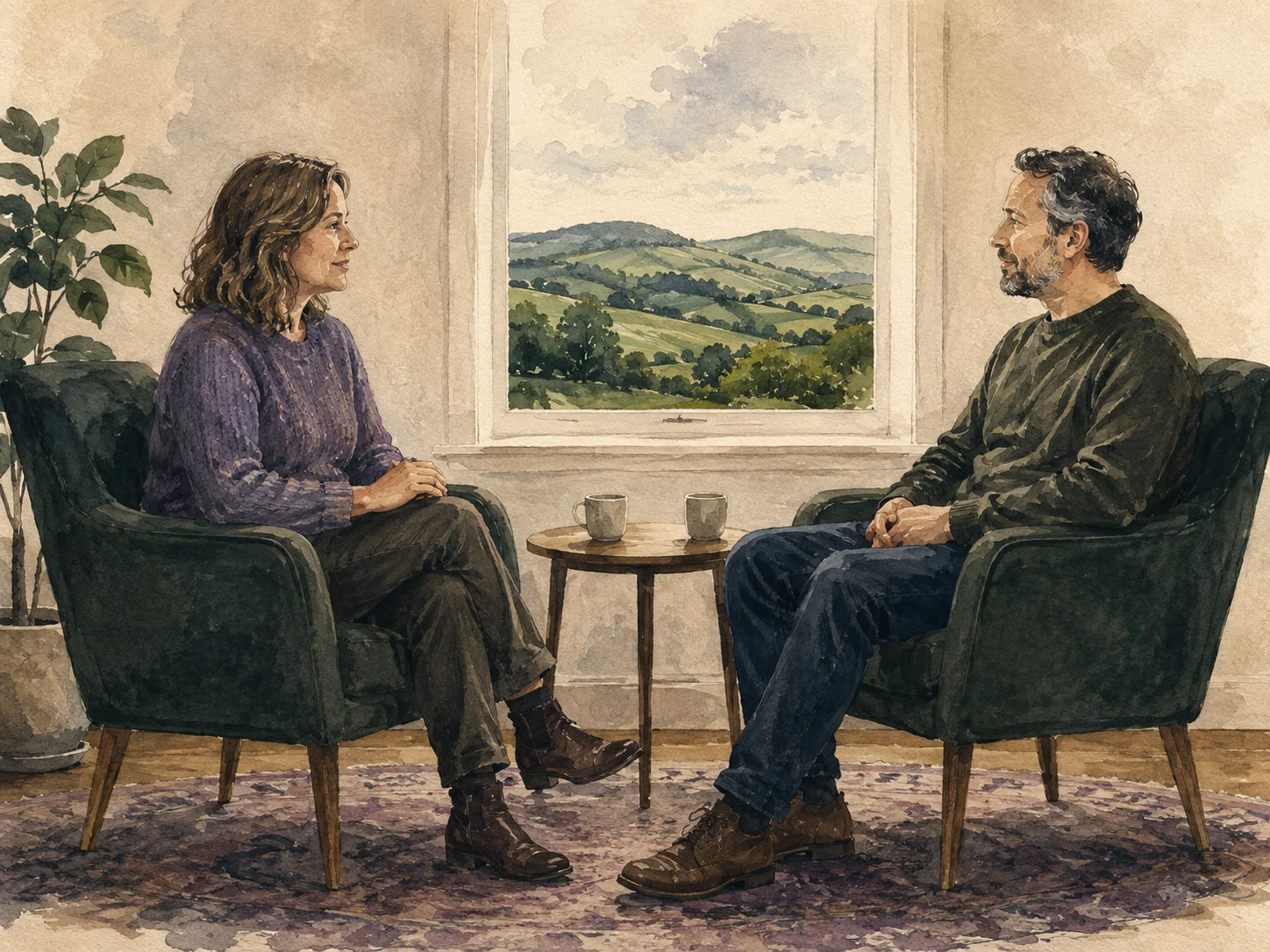
Watercolour illustration of two adults listening to one another in a quiet room, with hills beyond the window.

Care in community

A conversation rooted in Northern Ireland.

Slana brings emerging research into conversation with the priorities of local communities. People with lived experience should have a voice in how we talk about trauma care.

We want to understand how individual wellbeing shapes relationships and community life, and what communities need from trauma care.

Share a community perspective

The Slana introduction

The conversation behind our work.

Meet Slana, and explore the ideas behind our work on trauma care and community wellbeing.

2 minutes 35 seconds · English captions

Read the full transcript

00:00Slana. Psychological trauma has powerful new treatments.

00:07Trauma doesn't simply fade. It lives on in the body, in families, and in whole communities. In places that have known conflict, like Northern Ireland, its imprint can last for generations, keeping people trapped in cycles of fear, hypervigilance, and pain.

00:31Entheogenic medicines, such as psilocybin and MDMA, work at the deepest level of the brain. Under professional guidance, they can release emotional trauma that has been locked in place for years or decades, and dissolve the conditioned responses that keep people stuck.

00:53The science is remarkable. In a phase-three trial published in Nature Medicine, MDMA-assisted therapy brought significant relief to people with severe PTSD. Studies at Johns Hopkins, Imperial College London, and Yale show that a single dose of psilocybin can lift depression for weeks, and spur the growth of neural connections lost to depression itself.

01:22The world is taking notice. The FDA has granted psilocybin Breakthrough Therapy status. Australia now allows psychiatrists to prescribe MDMA and psilocybin. And nearly a hundred cities have moved to decriminalise these medicines.

01:43These lands used entheogenic plant medicines for thousands of years. Modern research is confirming what ancient cultures knew: these substances can catalyse profound healing. And when even one or two people in a community begin to heal, the effects ripple outward, through families, relationships, and communities. That is a path towards peace.

02:14It's time to bring these medicines, safely and legally, to the places that need them most, guided by trained professionals. Learn more, explore the research, and join us at slana dot org. Slana: healing trauma at its roots.

Keep exploring

A place for thoughtful reading.

Studies, reporting and organisations exploring psychedelic-assisted therapy, trauma care and community wellbeing. Open a topic to browse.

External links open in a new tab.

Northern Ireland and Ireland3 links
The wider conversation9 links
Community and peacebuilding3 links
Research and scientific reporting23 links
Health and wellbeing24 links
Policy and awareness18 links
Organisations and further resources15 links

Get in touch

Let’s begin a thoughtful conversation.

For general enquiries about Slana, research, collaboration or community perspectives.

Please keep your first message brief. Avoid medical records or other sensitive personal information.

General enquiry

All fields are required.